

Knowledge that Builds Better Futures
At Ruby Sand, we don't just deliver materials—we deliver clarity, confidence, and the knowledge to build smarter. Whether you're a first-time home builder, a seasoned contractor, or a curious learner, we are your trusted companion in your construction journey.
This is written to simplify the complex, spark ideas, and guide decisions—because we believe an informed builder is an empowered one.
Ruby Sand vs River Sand: What's Better for Your Project?
Explore the key differences and discover why engineered sand is reshaping the future of construction.
| Name | RIVER SAND | RUBY SAND |
|---|---|---|
| Source & Extraction |
❌ Extracted from fragile riverbeds ❌ Unregulated and unsustainable |
✅ Manufactured from selected rock ✅ Processed in a controlled facility |
| Particle Shape & Structure | ❌ Rounded particles reduce concrete bonding | ✅ Cubical, angular particles enhance concrete strength |
| Cleanliness & Impurities | ❌ Contains marine salts, organic matter, clay and silt | ✅ Clean, zero impurities, ready to use |
| Consistency & Quality Control |
❌ Quality varies with location and seasons ❌ Inconsistent grain sizes |
✅ Uniform grain size and shape ✅ Controlled production ensures consistent quality |
| Strength & Performance in Concrete | ❌ More voids, poor cohesion and reduced compressive strength |
✅ Excellent gradation ✅ Higher compressive strength and durability |
| Fines Content & Workability | ❌ May require extra processing to balance fines | ✅ Optimum fines content reduces segregation, bleeding and honeycombing |
| Availability & Supply | ❌ Limited supply due to seasonal conditions and regulations | ✅ Available in huge quantities year-round |
| Environmental Impact | ❌ Depletes river ecosystems and groundwater recharge zones | ✅ Eco-friendly alternative that helps conserve groundwater levels |
| Economic Advantage | ❌ Expensive due to processing, wastage and transport | ✅ Cost-effective, zero wastage and optimized usage |
A builder's guide to what grading means, why it matters, and how it affects the strength of your structure.
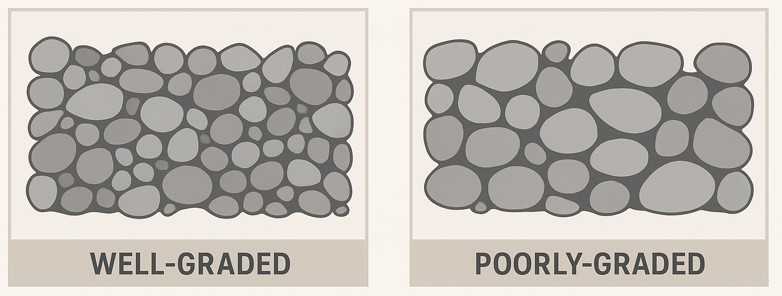
What is Aggregate Grading?
Aggregate grading refers to the distribution of particle sizes in sand, gravel, or crushed stone. Proper grading ensures that the particles fit together efficiently, reducing voids and increasing density.
Whether you are laying a highway base, producing ready-mix concrete, building railway tracks, or plastering a wall, the grading of your aggregates directly influences load-bearing capacity, crack resistance, and longevity.
At Ruby Sand, we use state-of-the-art screening and washing technology to achieve consistent grading in every product category. When you choose Ruby Sand Aggregates, you're not just buying materials—you're investing in precision-engineered grading that ensures strength, durability, and performance in every application.
Stay ahead of the curve—because building right starts with knowing right.